
this is my little Bradford pear tree that is only about 5 years old. It had more blossoms this year than it had last year. I have another one by the front door. It only has a few blossoms but is a much bigger tree.
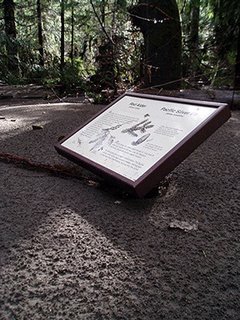 Snow is accumulating at Paradise. I measured 46" total, with 15" of fresh snow this morning. It looks and feels like winter and if the park were open, skiers, boarders and snowshoers would be enjoying the early snowfall. But the floods really did a number on the roads and as the days pass, it becomes more clear how complicated the damage is, especially with the prompt arrival of winter.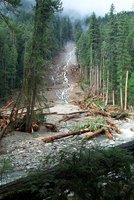
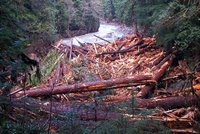 Here is the primary deposition zone for all of the timber that was unearthed in the same landslide.
 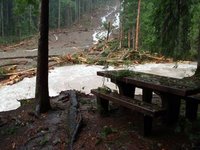 The river also moved and in doing so, took a couple of the campsites with it. Here is the new loop C of Ohana.


 On the afternoon of Tuesday, July 1, a climber fell approximately 15 feet into a crevasse at around 11,400 feet on the Kautz Glacier of Mount Rainier while descending the Mountain. The injured climber, Mitchell Bell, was rescued from the crevasse by his four teammates. Bell had injured ribs and visible lacerations to his head and face, but he was conscious and in stable condition. A doctor in the team quickly determined that due to his known and potential injuries, Bell could not continue the descent without assistance. Two members of the party climbed down in search of help, leaving the doctor, another teammate, and the patient at the scene. Back at Camp Hazard about 1,000 feet below, they found Alpine Ascents International (AAI). Several AAI guides responded to the request for assistance and contacted the National Park Service. A plan was put in place for two AAI guides to travel to the accident scene that evening to assess the injured climber’s condition and bring with them materials for an overnight stay on the Mountain. Based on their assessment, the Incident Commander, David Gottlieb called for air-lift/hoist extraction the following morning.
 Within an hour of take-off on Wednesday morning at approximately 6:45 a.m., a US Army Reserve Chinook helicopter from Fort Lewis successfully extracted the injured climber from the Kautz Glacier. The patient was transported to Madigan Hospital for further medical evaluation. He was released later that day.
  Old railway carriage at the Northampton and Lamport railway. Well worth a visit they have there own web page just click on the link for news, history and upcoming events
 Old British railways sign on a carriage
 Steam saddle tank loco
 Diesel loco under wraps
 Pitsford and Brampton signal box and brake carriage
 Just reward..
