Don't get me wrong: I am glad to see so many shoppers patronising establishments in their local town centers instead of going to the mall or shopping online. I've heard campaigns on the radio promoting local holiday shopping, and I am certain that I am seeing more of this trend now than in previous years. The lively community feeling seems to be returning to places where it had been absent for years; it's fantastic. But assuming that most of the holiday shoppers are indeed local (why else would they visit tiny stores selling things like bespoke stationery, knitting yarn, baby clothing, and jewelry crafted by women who teach at the local arts center?) it is ironic that they choose to drive. Parking alone must eat up a good portion of their lunch hour, which probably explains why they run in and out of the shops like mad, swing open their car doors without looking, then shout in irritation at cyclists like me merely for being there and almost getting killed by them. They would probably be happier if they walked, as would the rest of us. I know that some town centers have considered banning parking or car traffic during peak shopping times, but there is resistance from business owners - who believe this will deprive them of customers.
Go where he will, the wise man is at home His harth the earth, his hall the azure dome. -----R.W.Emerson
Friday, April 12, 2013
Bells Are Ringing, Car Doors Flinging... Holiday Time in the City
Don't get me wrong: I am glad to see so many shoppers patronising establishments in their local town centers instead of going to the mall or shopping online. I've heard campaigns on the radio promoting local holiday shopping, and I am certain that I am seeing more of this trend now than in previous years. The lively community feeling seems to be returning to places where it had been absent for years; it's fantastic. But assuming that most of the holiday shoppers are indeed local (why else would they visit tiny stores selling things like bespoke stationery, knitting yarn, baby clothing, and jewelry crafted by women who teach at the local arts center?) it is ironic that they choose to drive. Parking alone must eat up a good portion of their lunch hour, which probably explains why they run in and out of the shops like mad, swing open their car doors without looking, then shout in irritation at cyclists like me merely for being there and almost getting killed by them. They would probably be happier if they walked, as would the rest of us. I know that some town centers have considered banning parking or car traffic during peak shopping times, but there is resistance from business owners - who believe this will deprive them of customers.
Thursday, April 11, 2013
Abandoned Gear
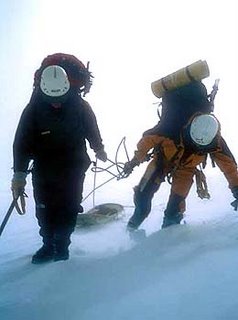
In the 05/06 winter, three separate climbing teams reported being caught in significant storms. Two were below Camp Muir, and one was higher on the Ingraham Glacier.While getting lost or pinned down in a storm on Mount Rainier isn't that unusual given the time of year, it was interesting to note that all three teams retreated to snowcaves. Pure and simple, shovels are mandatory. And that means one for each person. One team said that they broke three of their shovels while digging. Thankfully, there were four of them!
These teams were helped by their size; two were 4-person, one was 5. It’s a lot easier to pull through a storm with extra people around. And as the storms relented, each team made their way back to Paradise without assistance, but not without some cost.
Two of the teams abandoned a significant amount of equipment; gear such as tents, bags, stoves and pads. Each stated that they could not retrieve all of the equipment because of the intensity of the storm and snow accumulation. Tents, for example, were nearly impossible to dig out. To them, it seemed safer to retreat; this is a tough decision to make.
It can’t be overstated, winter AND spring storms can be particularly fierce on Mount Rainier. If you’re pinned down and must abandon camp (high winds, snowfall, avalanche/icefall exposure), do all you can to retrieve at least your stove, pad, clothing and bag. One tip is to pack your pack before exiting the tent.
Though a rapid exodus to Paradise or Camp Muir may seem appealing given the current circumstances, it has also led to many notable accidents and fatalities. Caught on the mountain with only a shovel and few odds and ends is a downright brutal experience to live through.
Photo by Mike Gauthier
Ah, Spring!
It's that time of year when Mother Nature can't decide whether it is should still be winter or if she'll let us pass into warmer weather. Last night saw thunder and lightening along with quite a bit of rain come through northeast Indiana. Then I heard it turn to sleet and freezing rain. I looked out the back door about 11 p.m. and there was at least an inch of slush on the patio. By then the mixture had turned to snow. The front of the apartment, which faces the south and which is where the flowers are, didn't get near as much snow/slush as the north side.
So, will my daffodils bloom when their time comes?

As always, click on the image for a larger version...
So, will my daffodils bloom when their time comes?

As always, click on the image for a larger version...
Saturday, April 6, 2013
Fortress of Ice

This ice formation was photographed along the Grand Portage shoreline of Lake Superior a few days ago. It never ceases to amaze me the endless forms that ice can take along the shores of this great lake. This "fortress" of ice formed over the top of a large mound of rocks. As the rocks get pounded by the waves the water freezes and forms into ice. Every year the ice looks different, as it never freezes in the same exact shape. Often times even from one day to the next it will look different as new waves add new layers of ice, or warm days melt a layer of ice.
Acadia :: Carriage Roads and Bridges
From 1913 to 1940, John D. Rockefeller, Jr. was instrumental in constructing the beautiful carriage roads on Mount Desert Island, which would later become part of Acadia National Park. There are 45 miles of carriage roads (including 17 stone-faced bridges) available for walkers, bicyclists, equestrians and even carriages. In the winter, they can also be used for cross-country skiing.
The 'problem' with walking on the carriage roads is that the bridges are sometimes difficult to view. (This website has more photos of some of the bridges.)
It was easy walking along the carriage roads, even the uphill grades weren't too bad, and it was a pleasant way to spend the afternoon.

This bridge was at the southern end of Jordan Pond.

The roads and bridges were constructed
with manual labor. At times, there was a crew of 300 men working on
these roads.

Each of the bridges is different but
built to 'fit in' with the surroundings. This group of riders stopped
after we told them they were riding over a bridge. When you're on the
road it is sometimes difficult to know that you're on a bridge. Many
areas have the large stones bordering the roadway.

Another view of the same
bridge in the previous photo.

Some bridges, like this one, were
constructed with viewpoints that extended off to the side of the
road, which were nice so that you could actually see the bridge
itself.

This little bridge was
near the Bubble Pond.
The 'problem' with walking on the carriage roads is that the bridges are sometimes difficult to view. (This website has more photos of some of the bridges.)
It was easy walking along the carriage roads, even the uphill grades weren't too bad, and it was a pleasant way to spend the afternoon.

This bridge was at the southern end of Jordan Pond.

The roads and bridges were constructed
with manual labor. At times, there was a crew of 300 men working on
these roads.

Each of the bridges is different but
built to 'fit in' with the surroundings. This group of riders stopped
after we told them they were riding over a bridge. When you're on the
road it is sometimes difficult to know that you're on a bridge. Many
areas have the large stones bordering the roadway.

Another view of the same
bridge in the previous photo.

Some bridges, like this one, were
constructed with viewpoints that extended off to the side of the
road, which were nice so that you could actually see the bridge
itself.

This little bridge was
near the Bubble Pond.
It's Still There!
What's still there, you ask? The residence of John Brubaker, my 3rd great grandfather, that's what! Yesterday was an absolutely beautiful fall day here in northeast Indiana and I couldn't resist taking advantage of it. After running some errands, it was about 2:30 in the afternoon by the time I got to Huntington County. A few minutes later I was in the area where I thought the house should be, and there it was! It didn't quite look the same as in the image from the atlas, but I was pretty sure it was the right house. I pulled off to the side of the road and took a couple of pictures. The sun was in the "wrong" position for a really good shot, but it does show some of the details. The house is some distance from the road. Thank goodness for zoom lenses!
Comparing the two images, the first thing I noticed was that the pitch of the roof is steeper in the old image (artistic license perhaps?), several of the chimney's have been removed, and the brick exterior has been painted. The porch has been extended to the full depth of the offset and a sloped roof replaces the railed deck. There is only one entrance off of the porch into the house. The door going into the south facing section has been removed. The second window above the porch was actually a door. It too has been removed as has the "front" door (the empty space below the 3rd upstairs window). Modern insulated windows have replaced the originals, and the decorative thing-a-ma-jigs above the windows are gone.
Cropped portion of the picture used in the 1876 atlas, shown in a previous post.
Looking southeast, showing the room that was added onto the southwest corner of the house and some of the out-buildings.
After taking the pictures, I did something that I've never done before. I saw a car in the driveway so I drove up to the house. I was greeted by a very friendly black lab and a small golden haired retriever-mix. They didn't bark or make a sound, which I thought was odd. Anyway, I petted them for a minute and then went onto the porch and knocked on the door. No answer. I peeked around behind the house thinking perhaps someone was outside, but there wasn't anybody there. Went back on the porch and knocked on the door again. Still no answer. Waited a few minutes, knocked again. No answer. So I left. As I was driving down the lane out to the road, the school bus pulled up and dropped off several children. After speaking with them for a few seconds, I turned around and went back to the house, where their mother was waiting on the porch!
She hadn't heard me knocking on the door. She was very nice and friendly. I showed her a copy of the picture of John's house and she confirmed that it was the same house. She said that she was told that the house had been built in the early 1850s. She and her husband purchased the house eight years ago from a couple that had bought it about 1970. She didn't know who they had purchased it from.
After a few minutes of chatting on the porch she invited me inside. The walls are solid brick, at least 12" thick. It's hard to see from the pictures above, but the house is really two rectangular "sections" that are offset by the depth of the porch. So the back, or south facing section, is only as long as the north facing section. We didn't go down into the basement but I didn't think to ask whether it was a full or partial basement or whether its walls were stone or brick.
There are two fairly large rooms on each floor of the front section. There is just one large room in the back section on each floor but the enclosed stairway is also on that side of the house. At the top of the stairs there is a large landing area that has been converted into a closet and a hallway. I was surprised by the height of the rooms upstairs as they have 8' ceilings. I was expecting them not to be as high as those downstairs. There are no fireplaces left in the house.
The only change to the original footprint of the house is the addition of a room at the back, southwest corner, downstairs. It is actually two small rooms. One is being used as the laundry room and back entrance and the other is a galley-type kitchen.
All in all, I must say, it was a very nice day!
Comparing the two images, the first thing I noticed was that the pitch of the roof is steeper in the old image (artistic license perhaps?), several of the chimney's have been removed, and the brick exterior has been painted. The porch has been extended to the full depth of the offset and a sloped roof replaces the railed deck. There is only one entrance off of the porch into the house. The door going into the south facing section has been removed. The second window above the porch was actually a door. It too has been removed as has the "front" door (the empty space below the 3rd upstairs window). Modern insulated windows have replaced the originals, and the decorative thing-a-ma-jigs above the windows are gone.
Cropped portion of the picture used in the 1876 atlas, shown in a previous post.
Looking southeast, showing the room that was added onto the southwest corner of the house and some of the out-buildings.After taking the pictures, I did something that I've never done before. I saw a car in the driveway so I drove up to the house. I was greeted by a very friendly black lab and a small golden haired retriever-mix. They didn't bark or make a sound, which I thought was odd. Anyway, I petted them for a minute and then went onto the porch and knocked on the door. No answer. I peeked around behind the house thinking perhaps someone was outside, but there wasn't anybody there. Went back on the porch and knocked on the door again. Still no answer. Waited a few minutes, knocked again. No answer. So I left. As I was driving down the lane out to the road, the school bus pulled up and dropped off several children. After speaking with them for a few seconds, I turned around and went back to the house, where their mother was waiting on the porch!
She hadn't heard me knocking on the door. She was very nice and friendly. I showed her a copy of the picture of John's house and she confirmed that it was the same house. She said that she was told that the house had been built in the early 1850s. She and her husband purchased the house eight years ago from a couple that had bought it about 1970. She didn't know who they had purchased it from.
After a few minutes of chatting on the porch she invited me inside. The walls are solid brick, at least 12" thick. It's hard to see from the pictures above, but the house is really two rectangular "sections" that are offset by the depth of the porch. So the back, or south facing section, is only as long as the north facing section. We didn't go down into the basement but I didn't think to ask whether it was a full or partial basement or whether its walls were stone or brick.
There are two fairly large rooms on each floor of the front section. There is just one large room in the back section on each floor but the enclosed stairway is also on that side of the house. At the top of the stairs there is a large landing area that has been converted into a closet and a hallway. I was surprised by the height of the rooms upstairs as they have 8' ceilings. I was expecting them not to be as high as those downstairs. There are no fireplaces left in the house.
The only change to the original footprint of the house is the addition of a room at the back, southwest corner, downstairs. It is actually two small rooms. One is being used as the laundry room and back entrance and the other is a galley-type kitchen.
All in all, I must say, it was a very nice day!
Wednesday, April 3, 2013
Gaitered mtn/ice boots? Batura / Phantom / Ultra

Just for the sake of convenience I thought all these should be in the same place for easy reference.
http://coldthistle.blogspot.com//02/the-scarpa-rebels-part-one-ultra.html
http://coldthistle.blogspot.com//01/scarpa-phantom-ultra-vs-la-sportiva.html
http://coldthistle.blogspot.com//02/new--la-sportiva-batura_14.html
http://coldthistle.blogspot.co.uk//04/scarpa-phantom-guide-vs-la-sportiva.html
6000 specific
http://coldthistle.blogspot.com/search?q=6000
Subscribe to:
Posts (Atom)